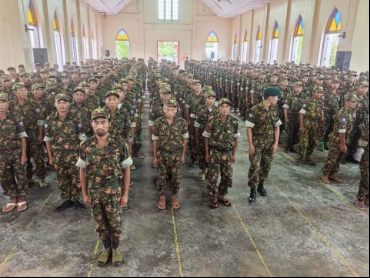
The militia has held a graduation ceremony for hundreds of fighters inside the sanctuary of one of the churches, prompting local Christian leaders to condemn the act as a violation of religious freedom and call for United Nations intervention.
The Shanni Nationalities Army (SNA), a militia allied with the military, captured Nant Mun Baptist Church in the Nantmun area of Mohnyin Township in Kachin State, while the military took over St. Michael’s Catholic Church in the village of Bye Malut near Katha town, in the neighbouring Buddhist-majority Sagaing Region.
A town emptied of its Christians
The SNA occupied the Baptist church in Nantmun after most of the local Christian population fled in late 2024, according to UCA News. The military’s occupation of the Catholic church in Sagaing was confirmed in October 2026 by Agenzia Fides.
The precise dates on which the two churches were seized remain unclear.
Nantmun had a predominantly Christian population belonging to the Kachin ethnic minority, in a country where most people are Buddhist. More than 400 of the town’s roughly 500 Christian households fled the SNA advance for their safety. About 80 Kachin Christian households remain, unable to afford to relocate. The occupiers bar them from work or trade, they survive by foraging for wild roots, plants, fish and frogs in nearby forests and waterways, according to reports.
The Catholic church building is being used for military purposes, including storing weapons, and can no longer hold religious services, while the military is using the Baptist church as a training centre.
Places of worship under military use
On 23 September, the militia held a graduation ceremony for more than 400 fighters inside the sanctuary of the Baptist church in the presence of the head of the Myanmar military’s Northern Regional Command, Major General Aung Zaw Htway, according to Burma News International.
Militia members danced and drank alcohol inside the sanctuary during the ceremony, U.S.-based Kachin Baptist leaders said in a statement on 5 October, urging U.S. President Donald Trump to act.
“Conducting a military graduation ceremony inside the church sanctuary is an insult to Kachin Christians and to the Kachin people as a whole… I respectfully request that the White House redesignate Burma as a Country of Particular Concern, or CPC,” Rev. Lakang Dau Qae, General Secretary of the Kachin Baptist Churches USA, said in the statement.
The SNA represents the predominantly Buddhist Shanni people. Founded in 1989 and reactivated in 2016, it has fought for a self-administered Shanni state covering parts of Kachin State and Sagaing Region. It has a long-standing rivalry over territory and resources with the Kachin Independence Army (KIA), one of Myanmar’s largest ethnic armed groups, whose members are predominantly Christian.
Local Kachin Christian leaders also called the ceremony a violation of religious freedom and urged United Nations intervention, according to Fides.
Kachin political analyst Ko Mardi was quoted as saying, “Armed groups must not disrespect or occupy places where civilians practice their religion. Using Christian places of worship for military operations and training is a clear breach of international law.”
The Kachin Baptist Churches USA called the act of desecration part of a wider pattern of military assaults on Christian and ethnic minority communities in Myanmar.
Christians targeted during the conflict
Myanmar has experienced armed conflict since gaining independence from Britain in 1948, with ethnic minority groups, including Christians, fighting successive governments for autonomy and greater political rights.
The conflict intensified after the Buddhist nationalist military overthrew the elected civilian government in February 2021, prompting a new wave of armed resistance that joined forces with several longstanding ethnic insurgencies. Since then, resistance groups have captured large areas of the country, including towns, military bases and strategic border crossings.
The military has since lost control of large parts of the country to ethnic armed organisations and pro-democracy resistance forces. According to an August 2026 assessment by the Council on Foreign Relations, resistance forces controlled approximately 42 percent of Myanmar’s territory, while the military firmly controlled only about 21 percent, with the remainder contested or outside the firm control of either side.
The military retains control of major cities and relies heavily on airstrikes against resistance forces and civilians.
The junta has repeatedly attacked religious and cultural sites associated with ethnic and religious minorities, which the military sees as symbols of their distinct identities and aspirations for autonomy. The U.S. Commission on International Religious Freedom reported in its 2026 annual report that military forces destroyed 379 religious sites in 2025, killing more than 259 clergy and civilians who were sheltering in them or taking part in religious activities.
In Christian-majority Chin State in western Myanmar, Baptist Pastor Dal Thawn Tuang, 49, an assistant pastor at Lamzang Baptist Church who had served the community for 22 years, was shot dead near a bridge on 14 September while returning from ministry in a nearby village, Fides reported.
Obligations under international law
Myanmar’s military junta faces international sanctions and investigations into alleged war crimes and crimes against humanity. The European Union extended sanctions against 105 individuals and 22 entities until April 2027, while the United States, Britain and Canada maintain restrictions targeting military leaders and businesses linked to the regime.
The United Nations’ Independent Investigative Mechanism for Myanmar continues to collect evidence of atrocities for possible prosecutions. The International Criminal Court prosecutor has also sought an arrest warrant for junta leader Min Aung Hlaing over the persecution and forced deportation of Rohingya Muslims in 2017, while an Argentine court has issued arrest warrants for 25 suspects, including senior Myanmar military officials, over alleged crimes against the Rohingya.
However, in recent months, the U.S. government under President Trump has begun holding quiet talks with Myanmar’s military regime, apparently with the goal of improving relations and gaining access to Myanmar’s rare earth resources.
Despite these ongoing international actions, Myanmar continues to violate its commitments to religious freedom. Article 18 of the Universal Declaration of Human Rights protects everyone’s right to manifest their religion through worship, observance, practice and teaching, individually or in community with others, in public or in private. Myanmar’s 2008 Constitution, drafted under the previous military government, also guarantees citizens the right to freely profess and practice their religion.
Myanmar is also a party to the 1954 Hague Convention for the Protection of Cultural Property in the Event of Armed Conflict, having ratified it on 10 February 1956. The convention obliges states to refrain from using cultural property, including religious monuments, for purposes likely to expose it to destruction, and to prevent its pillage, and its Article 19 extends these duties to internal armed conflicts.
No longer a country of particular concern
The Kachin Baptist Churches USA pointed out that under the International Religious Freedom Act of 1998, Myanmar had been designated as a country of particular concern (CPC) for its severe violations of religious freedom from 1999 to 2023.
“Since then, Burma (Myanmar) has not been redesignated. In its 2026 Annual Report, the U.S. Commission on International Religious Freedom (USCIRF) recommends that the State Department redesignate Burma as a CPC. Redesignating Burma as a CPC would enable the U.S. government to take diplomatic and economic action against the Burmese military, including public condemnation, cancellation of official visits, targeted sanctions, and restrictions on assistance,” read the statement.