Karnig Kerkonian, an international lawyer and member of the Nagorno Karabakh Committee, delivered the speech below on 29 September 2026, at a CSI-hosted UN Human Rights Council side event dedicated to the rights of the people of Nagorno Karabakh three years after their expulsion by Azerbaijan.
Karnig Kerkonian: Appeasement does not work against genocidal intent
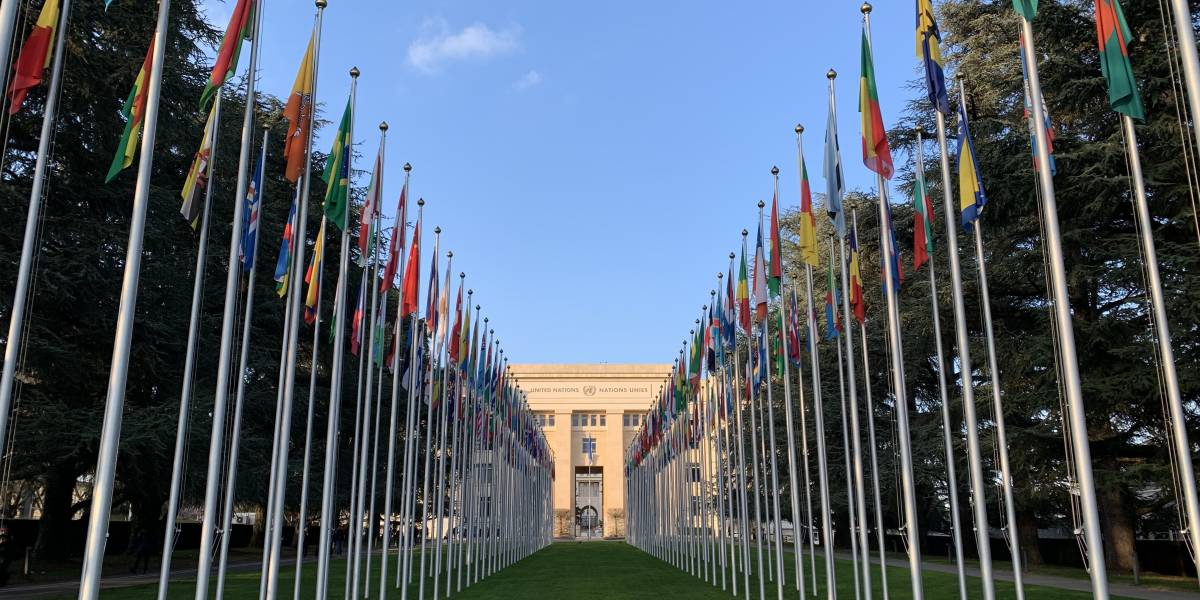
Diplomats laughed, danced, and cheered.
It was September 1938. Neville Chamberlain, the British prime Minister, took a fateful trip to Munich.
Hitler was eyeing the Sudetenland – and the startled Chamberlain scrambled to Germany, determined to get a peace treaty with Hitler.
He got one.
Hitler signed the Munich Treaty, in which he was allowed to keep the Sudetenland in exchange for not taking more. Chamberlain ran back to London, peace treaty in hand.
You know, there’s that famous picture of him standing in front of Downing Street, waving the treaty in celebration.
“Peace in our time” was the slogan.
But Hitler had different plans for Europe. He not only delivered war to Europe — he delivered genocide to Europe.
What Chamberlain missed, what he overlooked, was to become the colossal lesson of the last century: appeasement does not work in the face of genocidal intent.
Hitler had genocidal intent.
And when there’s genocidal intent, appeasement only fuels the perpetrator, it doesn’t stop him.
The taking of the Sudetenland was the beginning of Hitler’s plans, not the end.
Let’s put a pin in that for a second—and trace how we got here.
How the authoritarian dictator of Azerbaijan referred to Artsakh Armenians as dogs.
How his regime called Armenians rats, vermin and a cancer that needs to be cut out of society, whose government printed an official stamp of an exterminator in a hazmat suit “cleansing” Nagorno Karabakh before they actually did ethnically cleanse the Armenians.
Whose soldiers executed hog-tied Armenian boys, cut off the ears of elderly Armenian victims in their own homes, and sawed off the heads of Armenian elders with handheld knives.
We forget that, even after forcibly displacing the entire indigenous Armenian population, Aliyev posted a video on X where he stood in front of a bonfire stating that, now that he has rid Nagorno Karabakh of the Armenian people, he was going to burn away even the aura of the Armenians.
Go look, it’s still there.
This is the language of genocidal intent.
An authoritarian dictator who says Armenian churches are not Armenian churches at all, but Albanian churches and then uses a pocketknife to scrape away Armenian letters from the stone walls of churches, on video.
He is hard at work right now, destroying Armenian cross stones and cemeteries. You see, even the dirt is not allowed to have evidence of the Armenian people.
Aliyev is not done. Nagorno Karabakh is Aliyev’s Sudetenland.
It’s not the end of his conquest. It’s the beginning.
His military today sits inside Armenian territory. He refers to Armenia as Western Azerbaijan – he does not even consider Armenia a state. Think about that for a second.
Aliyev said on X: “Armenia is not even a colony, it is not even worthy of being a servant.”
This is impunity. Why would he stop? Would you?
Just over a week ago, Azerbaijan invited the diplomatic corps to Nagorno Karabakh.
And the diplomats came – and they laughed, danced, and cheered– pretending Armenian hostages do not exist, pretending Azerbaijan didn’t just wipe out an entire indigenous Christian Armenian civilisation in Artsakh from its roots, pretending that Azerbaijan is looking for peace.
The problem with pretending is, well, it’s pretending, isn’t it? And at some point, the make-believe fades away, and the harsh reality sets in.
The Armenian Genocide was the first phase of the destruction of the Armenian people, Nagorno Karabakh was the second — and if we do not hold Azerbaijan accountable this time, I am certain we will soon see, in our very own lifetimes, that fateful last and final phase.
And that phase, I assure you, won’t be pretend at all.
This is why Nagorno-Karabakh and the right of return matters so critically right now.
It’s not simply political aspiration. It’s not some sentimental demand of a displaced people.
It’s how you end appeasement. It’s how you curb genocidal intent. It’s how you prevent the next stage in the ongoing genocidal catastrophe that awaits the Armenian people.
We know that demanding the right of return is the right course.
In November 2023, the ICJ [International Court of Justice] ordered Azerbaijan to allow the Artsakh Armenian to return safely, without impediment, and expeditiously.
Incidentally, that order was issued in a case brought under CERD [Convention on the Elimination of All Forms of Racial Discrimination], the very convention implemented as a stop-gap measure to prevent – you guessed it – genocide.
The question now is not whether the Artsakh Armenian have a right to return. The question is how: how, in an environment where Azerbaijan continues to eradicate their homes, their churches and their very presence.
So what does a just return look like? It rests on 3 fundamental pillars:
First, return must be collective. It was an entire indigenous people and civilization that was displaced, not random individuals.
Second, return must be under international protection. This is necessary because there is genocidal intent.
And third, the Artsakh Armenians must be able return with their fundamental human rights intact because they are humans, and have a right to life and a right to self-determination.
A mechanism for this already exists, right here in Switzerland.
In fact, the Swiss Parliament has created a pathway for negotiations between representatives of Azerbaijan and representatives of the Nagorno Karabakh people: the Swiss Peace Initiative.
The rights exist. The tools exist. The people exist.
What’s missing is the political will of the international community to compel Azerbaijan to sit down at the table and face the people whose very existence it is trying so feverishly to destroy.
Thank you.
The full video of this speech can be watched here: https://youtu.be/UI4vIjl2oEQ?t=2353